
In order to tell her untouchable adopted “daughter-like” figure Sujata, about why is she different from all other upper castes in the family, Ammi uses the phrase “log toh tumhari parchai tak apne upar padne nahi dete”. And exactly at that moment, Sujata’s shadow cast on both walls adjacent to her moves away from Ammi as she does too. And this is the extent to which Bimal Roy uses cinema and symbolism to signify the tension on screen, and this case it almost mocks the irrationality and irony of the caste system.
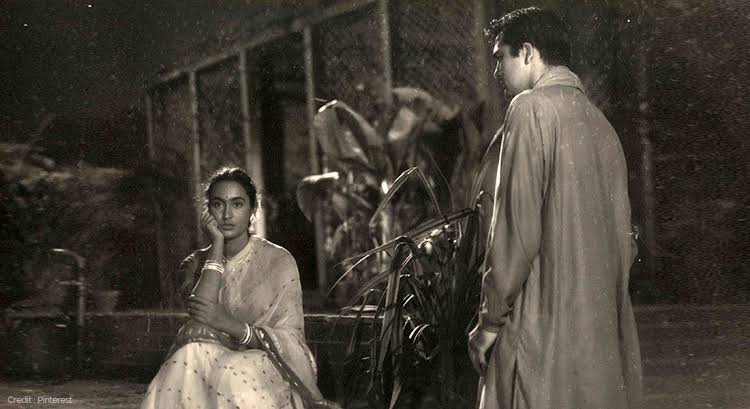
Mind you, the film came out in 1959, a time when untouchability was in practice in every household, quite like today but didn’t hide itself behind garbs of ‘open-mindedness’ or ‘acceptance’ of sorts.
Let me first layout the plot of the film; the film helms the story of Sujata (Nutan Behl), a lower caste untouchable, who is stranded all alone in the world after her parents’ demise and an upper caste Brahmin family adopts her for some time hoping to get rid of her soon. But to their dismay, nothing falls in place and Sujata grows up with them. Later, she falls in love with Adhir (Sunil Dutt), a Brahmin boy who was supposed to get married to their real daughter Rama (Shashikala). And what follows is an excruciating story of how caste plays a role in making life hell for Sujata and Adhir.
What is so pleasant to watch is the absence of unnecessary stereotypical subplots like a rivalry between two stepsisters over a man. Roy never divulges from the issue at hand, and while he is at it he breaks other stereotypes of mainstream cinema as well. But yes, it can also not be denied that maybe the lack of exposure to underlying problems pertaining to the caste system, the film somewhere reinstates the problem it achieves to solve. In a scene Adhir tries to make his Nani (Lalita Pawar) approve of Sujata with the argument that since she has grown up in a Brahmin household, she is in practice, a Brahmin too. The argument might eventually make things easier for Sujata, but sadly not for the caste system since it essentially means that caste is a derivative of people’s character.
Since it is close to a heinous crime, I simply cannot review any film from the golden age without talking about its music. The film isn’t quite taken forward through its music but two of my all time favorite songs ‘Jalte Hain Jiske Liye’ and ‘Kaali Ghata Chaye’ belong to this film and I can’t be more grateful to SD Burman for it. Stating the obvious, Sunil Dutt and Nutan make a beautiful pair and every sequence they’re in naturally becomes my favorite from the film.
One can never imagine how much Sujata’s narrative must’ve been frowned upon, in a country that wasn’t quite ready to admit its internal toxicity, in the name of religion, where practicing the caste system was law of the land. Yet, it gives me immense pleasure to know that filmmakers like Bimal Roy, who could’ve used the still budding Indian cinema for more commercial messaging means, quite responsibly used the platform to change the discourse of communication and embark upon change.

 The F Word