
On 5th August 2020, among so many other ‘important’ happenings, Kashmir completed an year under the revocation of article 370, and internet ban, to state it in layman language. And to remember the sacrifices of the people there, that they make every day for the past many many years, I decided to watch Vishal Bharadwaj’s brilliant film Haider. The experience was good in cinematic terms but abysmal whenever I had to hate my privileged self from what I saw in the frame. It is only so far ignorance can take us; when a scenic place like Kashmir is represented with undertones of devastation caused by daily violence (physical and bureaucratic), it hits like a hard realization that the place can no more inspire one with beauty, but only make us feel shameful. Some of the reviews I write turn a bit political, which I never want my writing here to be defined as. But nevertheless, some things are too important for my privileged soul to consider unnecessary for my blog. Hence, I state that some parts about it might comment on abuse of power.
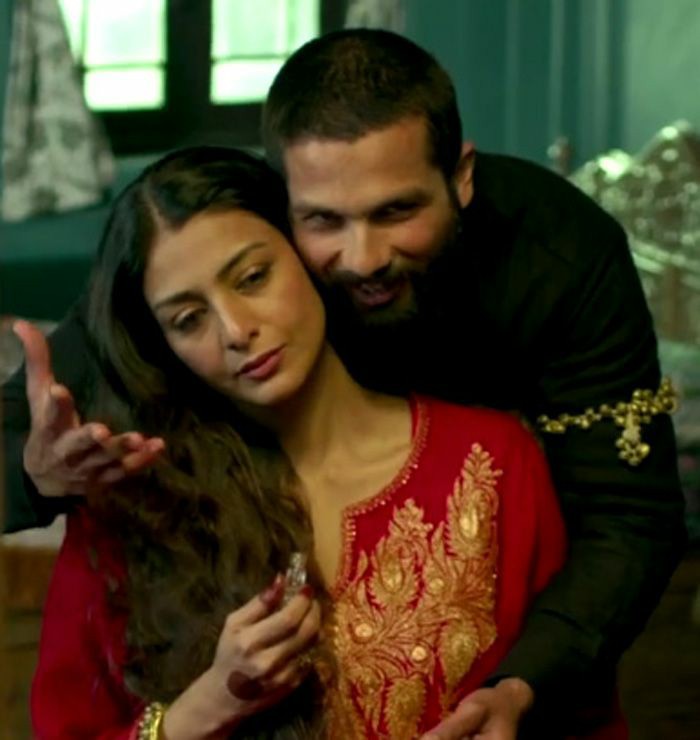
Haider, a film adaption of William Shakespeare’s Hamlet isn’t the first time Vishal Bharadwaj expressed his love for shakespeare’s writing but surely the first time he used a gravely complex political (and world) issue of Kashmir, for which he should be lauded. If you read or have read Hamlet, you will see how supremely infinite possibilities exist of its film adaptation. But fitting it in the backdrop of a real situation with so many political narratives, and literally going all out to portray young voices of Kashmir, is a bold move, and that too in 2014 which was just six years ago but painfully, the commercial film industry in India wasn’t as bold. That said, it is also a hard truth to gulp down that Shahid Kapoor did this film and when the industry is finally speaking up on humanitarian issues, did Kabir Singh.
The film unfolds with Hilal Mir (Narendra Jha), a doctor who helped out a militant in need of medical treatment and hence, lent him his own roof. Moments later we see his house blasted down to shackles, and despite trying not to go political, in one flash I was reminded of Dr Kafeel Khan, another man getting punished since 5 years for doing his job. With a simple google search you will know who and what I am referring to here. Moving on, post this debacle, Haider Mir, the doctor’s son returns to Kashmir and finds himself greeted with his father’s absence, his home in tatters and mother Ghazala (Tabu) least bothered by it all brewing romance with Hilal’s brother Khurram (Kay Kay Menon). That is what sets off the story of a rebellion headed by Haider and meant not just to seek justice for his father’s murder but subconsciously to make our minds churn and make us wonder about how important yet misused the Indian youth is.
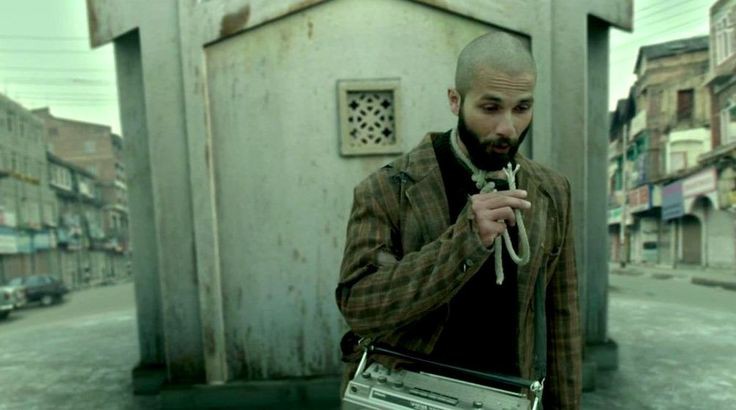
In the most iconic mid-street aazadi monologue by Haider, what was noteworthy to me was how cinema dared to speak up against the atrocities faced by people who harmlessly just happened be at the centre of a political propaganda of two countries, living life. If this was parallel or art cinema, this would hardly have been anything new but since its commercial, the impact and reach was two-fold. In essence makers like Vishal Bharadwaj aren’t legendary or great to be taking up such stories because that is how it should be, isn’t it? But it’s the lack of such initiatives that makes this one outshine mediocrity.
There are many seemingly harmless characters like the Salmans (Sumit Kaul and Rajat Bhagat) in this film too, whose death feels wrong and inhuman even though they sided with the wrong ones. Do you know why? It is because we are shown that their actions weren’t a result of choice but a will to keep their lives saved. Another narrative that made me wonder what is it that people of Kashmir can do and not be called out for? Not much I guess!
Marke hi pata chalta hai ki zinda rahe to jiye nahi aur mar ke bhi bache nahi
-Haider Mir
Talking about the two most important highlights of the film; acting performances and Vishal Bharadwaj’s music, I would only like to say that Tabu is literally the life of every frame she captures, Kay Kay Menon as Khurram and his sexual tension with Ghazala is so wrong yet deserves countless lauds for how its portrayed. To state the obvious, Haider is Shahid Kapoor’s career best performance and it shows why he is Bharadwaj’s favorite; his conviction to Haider’s role is spellbound. Khul Kabhi and Jhelum are two of my most favorite tracks from the film. Since the latter is rather unheard I would recommend lending it an ear.
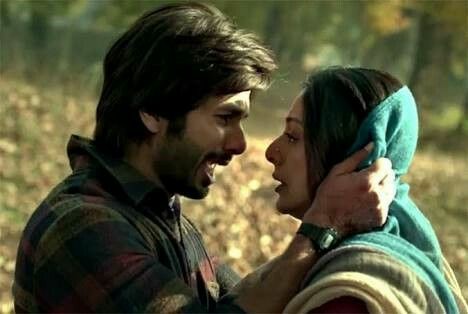
Haider in its entirety can have many interpretations. What’s yours?

 The F Word