
Alejandro Innarritu’s living masterpiece for decades to come, begins with a 30 minute long take, giving us a vague sense of what might be happening behind it, continuously and tirelessly in order to make the wonder happen on screen. This might give you an idea of what we’re dealing with here; cinema at its best teamed up with artistic assistances like long takes, mis-en-scene peaking at every corner, symbolism, unsaid and undefined narratives that leave room for subjectivity of thought and reception. All of this, garnished with beautiful performances of prowess by Emma Stone, Edward Norton and Michael Keaton, to name my favorites.
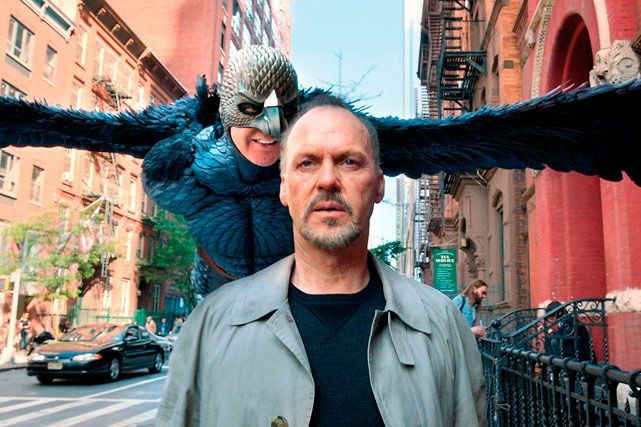
Based in New York, the film pans around the premise of an actor Riggan Thomson, who is fairly forgotten now that his only groundbreaking work Birdman is off the floors for years. He is determined to make a comeback through theatre this time, as director-actor-writer. The film is nothing but a journey from a few days before the play premiers at Broadway, to the day it does. It seems like the entire film is shot in one take, for which cinematographer Emmanuel Lubezki won the Academy Award. This ofcourse, is among the countless nominations and accolades the film received. And justifiably so, Birdman or The Unexpected Virtue of Ignorance is nothing short of a marvel.
Now, there isn’t ever going to be ‘enough’ words when one sets to describe Birdman’s powerful camerawork. Honestly, I was left hanging in the air with so many transitions, but I also won’t deny that a couple of them were too obvious. The film talks in ethical, artistic connotations of being an actor or anyone from the industry of performing arts. It highlights how the gray area in theatre or cinema, upon commercialization has only widened. So much so, that black and white seem made up or fictional in essence. So many media theories come to mind with portrayals of audience reception, and how even if not visible on the surface, it’s only capitalism that drives all the possible factors.
Birdman portrays Riggan with a constant alter-ego that keeps reminding him to reach for the stars, and in a way that never ever makes him settle. This inclusion is so peculiar that by the time you reach the climax, you either will be bewildered by what you just witnessed or you wouldn’t quite understand the point of all the elements intertwined. The way Riggan gets a new face in the end, the way his heart longs to fly high (literally) and the way his initial cynicism is suddenly something heroic in the face of profit and crowd reaping out of it, speaks volumes about one very important aspect of the society and also about Inarritu’s versatility as a filmmaker.
Riggan’s daughter Sam played by Emma Stone is showcased as living embodiment of what neglect and constant jeopardizing of self-respect can do to a person. She slams her father for still living in the body and soul of a fictional character that was “an entertainment for white people”. And not long after this, there’s a sequence where a black man shouts at Riggan saying, “You suck!”. What could be a better representation of a narrative visibly offensive to a group, while the privileged ones hail for it!
Many such hidden and visible portrayals make up for Birdman (or An Unexpected Virtue of Ignorance).


